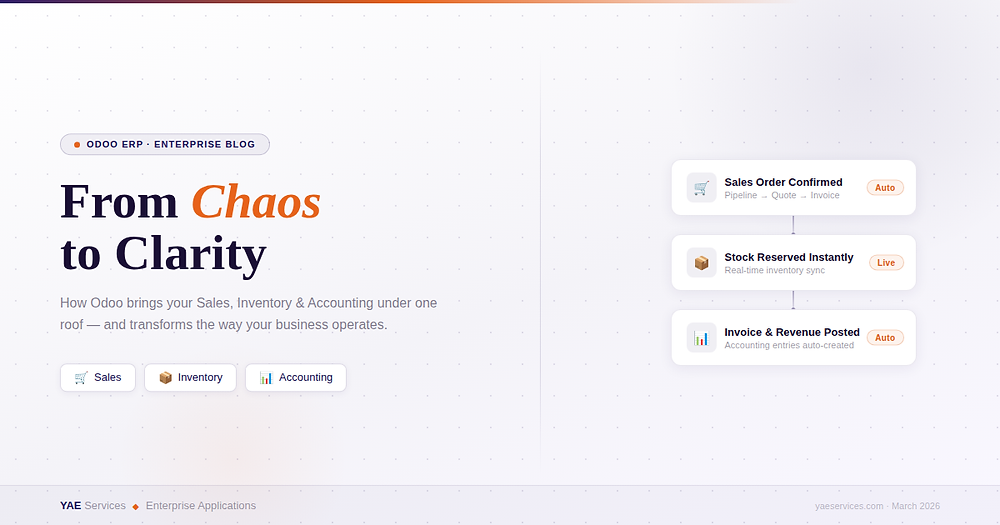
Running a growing business often feels like juggling ten systems at once — a sales CRM here, a stock tracker there, accounting in yet another tool, and a finance team drowning in manual reconciliations. Sound familiar?
That's the chaos Odoo is designed to eliminate. As one of the fastest-growing ERP platforms in 2026, Odoo unifies your core business operations — Sales, Inventory, and Accounting — into a single, seamlessly integrated platform. No more data silos. No more duplicate entries. Just one source of truth for your entire business.
In this blog, I break down exactly how Odoo makes that happen, and why more businesses are choosing it as their all-in-one business operating system.
The Problem: Disconnected Tools Kill Productivity
Most growing businesses run on a patchwork of tools — a standalone CRM, a separate inventory system, accounting software that doesn't talk to either, and a team spending hours each week manually syncing data between them. This creates real, measurable pain:
- Sales teams quote products that are already out of stock.
- Finance teams spend hours chasing invoices that weren't auto-generated.
- Management can't see real-time business health without pulling data from three different places.
The result? Wasted time, costly errors, and missed opportunities.
The Odoo Solution: One Platform, All Departments
Odoo solves this by connecting every department through a modular, fully integrated ERP system. Here's how the three core modules work together:
1. Sales Module — Close Deals Faster
Odoo's Sales module gives your team a powerful pipeline to manage leads, create quotations, confirm orders, and trigger invoices — all from one screen. What makes it stand out is what happens after a sale is confirmed: inventory is automatically updated, an invoice is generated, and accounting entries are created in real time. Zero manual intervention required.
2. Inventory Module — Total Stock Visibility
With Odoo Inventory, you get real-time stock tracking across multiple warehouses and locations. The system supports barcode scanning, lot/serial number traceability, automated reorder rules, and demand-driven replenishment. When a sales order is confirmed, stock levels are updated instantly — no manual adjustments, no overselling.
3. Accounting Module — Finance on Autopilot
Odoo Accounting automates the financial workflows that typically consume your finance team. AI-powered invoice scanning reads vendor bills and auto-fills fields. Bank reconciliation matches transactions automatically. Every sales order, inventory movement, and purchase order flows directly into your accounts — no double-entry, no lag.
Why Businesses Love the Integration
The real magic isn't any single module — it's how they work together. Here's a simple example:
- A customer places an order → Sales module confirms it.
- Stock is instantly reserved → Inventory module updates in real time.
- An invoice is auto-generated → Accounting module records the revenue.
- Payment is received → Bank reconciliation matches it automatically.
That entire flow — from order to cash — happens within Odoo, with no human needing to touch it. According to user reviews on G2, businesses report measurably faster billing cycles, fewer data mismatches, and full visibility from lead to invoice in a single system.
Is Odoo Right for Your Business?
Odoo is particularly well-suited for:
- SMEs and mid-market companies (10–500 employees) looking to replace disconnected tools.
- Businesses in retail, manufacturing, distribution, or professional services.
- Companies that want enterprise-grade functionality without the enterprise price tag.
Odoo Enterprise starts at $24.90/user/month — compared to SAP or NetSuite, which can cost 5–10 times more for equivalent functionality. The Community edition is free and open-source for businesses starting out.
Getting Started with Odoo
The right implementation makes all the difference. Many businesses choose to start with 3–5 core modules (typically Sales, Inventory, and Accounting), then expand as they grow. A qualified Odoo implementation partner can configure the system to match your exact workflows, migrate your existing data, and train your team.
At YAE Services, I help businesses across industries implement Odoo the right way — aligned with your goals, not just your IT checklist. Whether you're switching from QuickBooks, migrating from an older ERP, or starting fresh, I guide you every step of the way.
The Benefits of a Unified System
A unified system like Odoo offers numerous benefits. Here are a few key advantages:
Improved Efficiency
By integrating all departments, Odoo reduces the time spent on manual tasks. This allows teams to focus on what truly matters — growing the business.
Enhanced Data Accuracy
With one source of truth, the chances of errors decrease significantly. This leads to better decision-making and more reliable reporting.
Scalability
As your business grows, Odoo can easily adapt to your changing needs. You can add new modules and features without disrupting your existing operations.
Cost-Effectiveness
Investing in Odoo can save you money in the long run. With lower operational costs and reduced errors, the return on investment is clear.
Final Thought
The chaos of disconnected systems is a choice — and so is the clarity that comes with Odoo. When your sales, inventory, and accounting all speak the same language, your business moves faster, makes better decisions, and scales without friction.
Ready to bring your operations under one roof? Let's talk.