We get this question on every other discovery call: "Do we actually need an ERP, or is Tally fine?"
The honest answer most ERP vendors won't give you: if Tally is genuinely working, you don't need ERP. The migration project will cost you ₹2–₹10 Lakh, eat 3–6 months of management attention, and risk breaking your accounting cycle for one or two quarters. If your books are closing on time, your GST is calm, and your team isn't fighting reconciliation every Friday — keep using Tally.
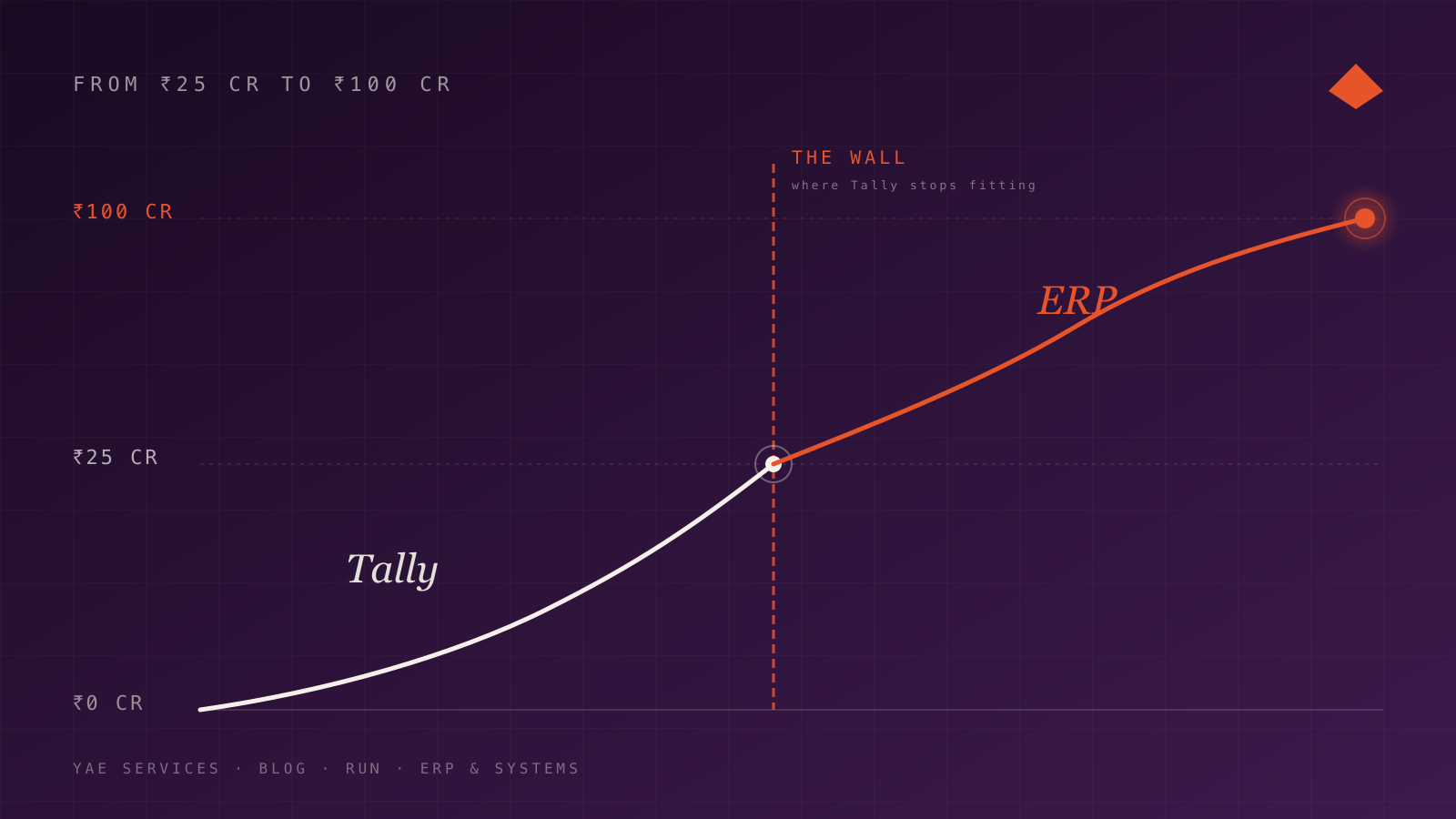
But Tally has a wall. Most Indian SMBs hit it somewhere between ₹20–30 Cr revenue. Here's what that wall looks like.
Five signals you've outgrown Tally.
None of these alone is enough. Two or more, and you should start scoping ERP. Three or more, and you're already losing real money to missing visibility — you just haven't measured it yet.
1. Closing books takes more than 10 days
Tally is built for accounting. When closing month-end takes a week and a half because someone has to chase POs, reconcile branch entries, and pull stock figures from three Excel sheets — Tally has stopped being your accounting tool and started being a symptom of fragmentation.
2. You can't answer "what's in stock right now" in under an hour
If your sales team has to call the warehouse, or someone has to open Excel, or "let me check and get back to you" is the standard answer to a stock query — your inventory has outgrown Tally. Modern ERPs (Odoo, Frappe) treat inventory as a live system: every sale, transfer, and receipt updates stock in real time across every branch.
3. Quarterly GST is a stress event
Tally handles GST. But the moment you have multi-branch operations, e-commerce sales coming through Shopify, vendor reconciliation, and HSN-level reporting needs — Tally becomes a bottleneck because data lives in too many places. ERPs centralise this, with the GST portal integration baked in.
4. Your sales team works in WhatsApp, not in your accounting system
This is the most common signal we see in growing Indian SMBs: the sales pipeline lives in WhatsApp and a Google Sheet. Customer history, deal value, follow-up dates — none of it is in Tally because Tally isn't a CRM. ERPs unify CRM and accounting; you stop losing context every time a deal moves between teams.
5. You've built more than three "automation hacks" around Tally
Excel macros that pull data from Tally. A WhatsApp bot that sends invoices. A custom report someone in your team rebuilds every month. These aren't features; they're patches on a tool that doesn't fit anymore. Each one is a single-person dependency.
"If your team has built three workarounds, the fourth one isn't another macro — it's an ERP."
The trap most teams fall into.
The mistake we see weekly: companies hit two or three of those signals, decide they need ERP, and then try to migrate everything at once. Accounting, inventory, sales, HR, manufacturing — all in one go, all in three months. This is how ERP projects fail.
Big-bang ERP deployments fail because:
- Your team is learning a new tool while still doing their day jobs
- Data migration mistakes compound across modules
- If go-live breaks, everything breaks at once
- You're paying full project cost before any module has proven value
Don't do this. Start with the one module that hurts most — usually accounting (because GST is brutal) or inventory (because stock visibility is killing your sales). Get that one module right. Run it in parallel with Tally for 30–60 days. Cut over for that one function. Prove value. Then expand to the next module when your team is ready.
Odoo, Frappe, or stay on Tally?
Quick decision framework based on what we've shipped:
- Stay on Tally if revenue is under ₹20 Cr, single-branch, and books close in under a week. You're not at the wall yet.
- Choose Odoo if you want polished UI, strong out-of-the-box modules (especially manufacturing/MRP and e-commerce), and have under 50 users. You'll pay per-user-per-module licensing — fair if you have specific module needs.
- Choose Frappe (ERPNext) if you have over 100 users, heavy customisation needs, or want zero licence fees forever. The UI is more utilitarian but it's deeply customisable, and the open-source community is genuinely active.
- Choose Zoho Creator if you don't need full ERP — you need one specific business app (field service, approval workflows, custom inspection forms). Low-code wins for niche workflows.
None of these are religious choices. We've implemented all four. The right answer depends on your team size, customisation appetite, and budget.
What a sane migration looks like.
If you're at the wall and ready to move, here's the rhythm we use on every Run engagement:
- Week 1–2 — Discovery. We map your current process. Where does data live? What breaks when someone is on leave? Which workflows are hand-off heavy? You sign off on which module migrates first.
- Week 3–6 — Build & configure. One module, configured to your business. Real data migrated from Tally. Weekly demos so your team sees progress, not status reports.
- Week 7–8 — Train & go-live. Role-based training, parallel run against Tally, weekend cutover. Your team owns it from day one.
- Week 9 onwards — AMC. Quarterly reviews. When the first module is humming, we scope the next one. You expand when you're ready, not when we want to upsell.
From scoping call to first module live: typically 8–10 weeks for ₹50K–₹1L. From first module to a 3-module connected suite: another 6–10 weeks. Full deployment: 4–6 months. None of it as one big project — all phased so each step earns the next.
The honest answer.
If you're reading this and one or two signals resonated — book a 30-minute operations audit. We'll look at your current process, tell you whether ERP is the right move, and walk you through the right starting module if it is.
If we think Tally is genuinely fine for where you are, we'll say so. We'd rather not start a project than start one that shouldn't happen.
Email [email protected], WhatsApp +91 84840 63453, or use the chat in the corner of this page. The assistant is trained on this exact playbook.