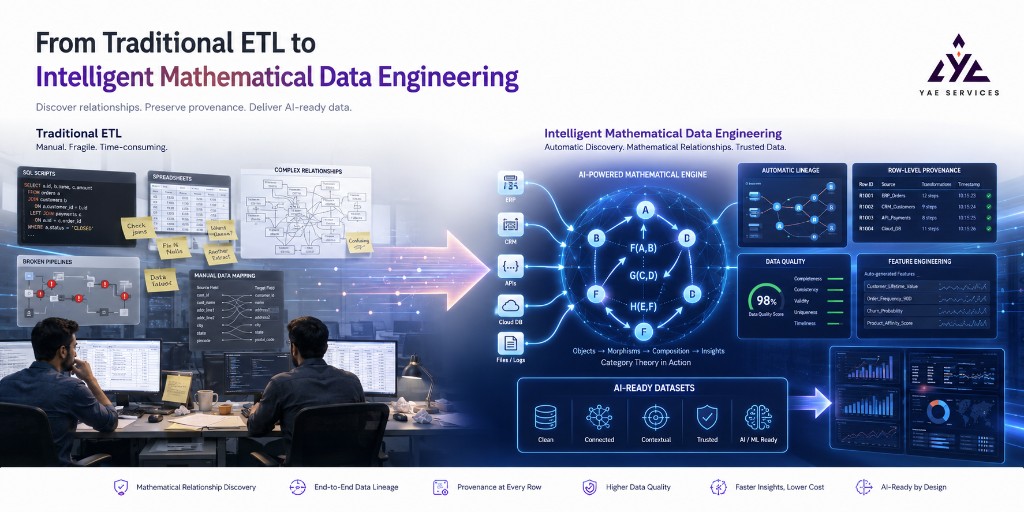
Data engineering has become the biggest bottleneck in AI and analytics.
Every organization wants to become data-driven. Yet most analytics projects don't fail because of dashboards, machine learning models, or visualization tools.
They fail much earlier.
They fail because building reliable datasets is still an expensive, manual, and error-prone engineering exercise.
Before a single dashboard is built or an AI model is trained, data engineers spend weeks—or even months—trying to answer questions like:
- Which source tables contain the required information?
- How are these entities related?
- Which joins are correct?
- What transformations are required?
- Can this feature even be created from the available data?
- If a number looks wrong, where exactly did it originate?
This work is commonly known as feature engineering, data integration, and ETL/ELT pipeline design.
Ironically, these activities are still performed using spreadsheets, whiteboards, SQL experimentation, documentation, and human intuition.
The result?
Long development cycles, inconsistent logic, fragile pipelines, and endless debugging.
The hidden cost of manual ETL
A traditional analytics project usually follows this pattern:
- Study source systems
- Understand relationships
- Create mapping documents
- Build ETL pipelines
- Materialize datasets
- Validate outputs
- Debug inconsistencies
- Repeat
Every schema change restarts much of the process.
Every new business requirement introduces another round of relationship analysis.
Every data quality issue becomes a detective exercise.
The engineering effort grows exponentially as data sources increase.
The real problem isn't SQL—it's relationship discovery
SQL engines have become incredibly powerful.
Cloud warehouses can process billions of records.
Spark and Databricks can scale almost infinitely.
Yet engineers still spend most of their time answering one question:
"How are these datasets actually related?"
Relationship discovery remains largely manual.
Developers inspect schemas. They compare foreign keys. They profile data. They validate assumptions.
Then they repeat the exercise at the data level because schema relationships rarely tell the whole story.
This consumes weeks before any business value is delivered.
Imagine if the relationships were mathematically guaranteed
Instead of manually discovering relationships, imagine a platform that understands the structure of your data mathematically.
Rather than asking engineers to manually build mappings, the platform derives them from formal models.
Instead of experimenting with joins through trial and error, the system determines whether a feature can actually be materialized from the available data.
This shifts ETL from an engineering exercise to a mathematical reasoning problem.
Research in category theory and algebraic data integration has shown that mathematically defined mappings can preserve relationships, constraints, and data integrity across heterogeneous systems.
From manual mapping to intelligent relationship inference
Traditional systems require developers to create relationship maps manually.
A mathematical approach can automatically:
- Infer entity relationships
- Validate mapping correctness
- Identify impossible transformations
- Expose missing source data
- Recommend optimal transformation paths
Instead of asking "Can we build this feature?", engineers immediately know:
- Yes
- No
- Why not
- Which data is missing
- Which transformations are required
That eliminates weeks of experimentation.
Data frames become a product—not a project
Creating an analytical dataset is often one of the longest phases of any analytics initiative.
Engineers manually combine:
- ERP data
- CRM data
- IoT data
- Spreadsheets
- APIs
- External datasets
Every integration introduces another layer of complexity.
A mathematically driven platform can automatically generate integrated data frames while preserving schema constraints, transformation rules, and lineage.
The objective is not simply to automate joins.
It is to guarantee that the resulting dataset is internally consistent and traceable.
ETL definitions can become self-generated
Traditional ETL development requires engineers to define:
- Joins
- Filters
- Aggregations
- Transformations
- Loading logic
Every new feature creates additional ETL code.
A relationship-aware platform can identify optimal transformation paths automatically and generate implementation-ready ETL logic.
Instead of manually writing hundreds of transformation rules, engineers validate generated logic.
This dramatically reduces development effort while improving consistency.
Data quality should be continuous—not an afterthought
Most organizations perform data quality checks after the data has already been transformed.
By then, identifying the source of an error becomes extremely difficult.
Teams spend days tracing incorrect numbers across multiple pipelines.
Modern data engineering demands quality checks at every level:
- Schema
- Table
- Row
- Individual cell
Fine-grained provenance and lineage research has demonstrated the value of tracing data transformations down to individual records and elements, making debugging and validation significantly more precise.
Instead of asking "Which report is wrong?", teams can immediately identify:
- Which source created the anomaly
- Which transformation introduced it
- Which downstream datasets were affected
Provenance should be built into every transformation
Lineage has traditionally been treated as documentation.
Modern systems should treat provenance as a first-class capability.
Every output should answer:
- Where did this value come from?
- Which source systems contributed?
- Which transformations were applied?
- Which business rules were executed?
- Which version of the pipeline produced it?
Built-in provenance improves compliance, governance, debugging, auditability, and trust in analytics—without additional documentation effort.
Version control should exist at the data level
Most teams version only their code.
But what about the data?
Modern platforms can track:
- Dataset versions
- Schema evolution
- Row-level lineage
- Transformation history
This makes reproducing historical reports significantly easier while supporting regulatory and operational requirements.
The future of ETL is composable
Many legacy ETL platforms create vendor lock-in.
Pipelines become difficult to extend, migrate, or reuse.
A modern architecture should generate implementation-ready code that can execute across today's data ecosystem, including:
- Apache Spark
- Python
- Databricks
- Cloud-native data platforms
- Custom execution environments
Instead of locking organizations into proprietary workflows, the engineering output becomes portable, reusable, and extensible.
Why this matters for AI
Artificial Intelligence is only as reliable as the data it consumes.
Poor relationship mapping leads to:
- Incorrect features
- Inconsistent training datasets
- Hallucinated business insights
- Unreliable predictions
By introducing mathematically verified relationship modeling, automated provenance, and deterministic feature engineering, organizations create higher-quality datasets that improve both analytics and AI outcomes.
The objective isn't merely faster ETL.
It is trustworthy data by design.
Final thoughts
The data engineering industry has spent decades optimizing execution engines.
Today's challenge is different.
The next generation of innovation lies before execution begins—in understanding relationships, validating transformations, guaranteeing lineage, and automating feature engineering with mathematical rigor.
Organizations that reduce manual reasoning from weeks to minutes won't simply build dashboards faster.
They will build analytics platforms that are explainable, reproducible, auditable, and AI-ready from day one.
For businesses investing in advanced analytics, digital transformation, or enterprise AI, this represents a fundamental shift from manual ETL development to intelligent data engineering.